“Microwave safe” and “ovenable” are two of the most misused claims in food packaging. They sound like a yes/no property of the material, but they are really a statement about a specific structure, food, temperature and time. A tray that survives a 3-minute microwave heat of rice may warp in 3 minutes of a fatty sauce, and a tray that is fine at 200°C may crack when taken from a freezer straight to the oven. This guide explains the real ratings so you can specify the right pack for ready meals, takeaway reheating and retail.
Three Different Questions
- Microwave heating. Microwaves heat the food, not the pack. The pack only has to cope with heat conducted back from the food (water-rich food stays near 100°C; fatty or sugary food can reach well above that) and not leach anything unsafe.
- Conventional or convection oven. The pack is heated directly by air at 180–230°C. Only a few plastics and fibre structures tolerate this.
- Freezer to heat. Cold brittleness plus thermal shock. A material good at 120°C can still fail at −20°C.
Material-by-Material Temperature Guide
| Material | Typical continuous range | Microwave | Oven | Freezer |
|---|---|---|---|---|
| PP (polypropylene) | about −20 to 120°C | Yes, standard microwave-grade | No | Yes, but can become brittle at very low temperature |
| CPET (crystallised PET) | about −40 to 220°C | Yes | Yes, dual-ovenable | Yes |
| APET / PET (clear) | about −20 to 60°C | No | No | Chilled / cold only |
| PS / foam | low; deforms near 70-90°C | Not recommended | No | Limited |
| Bagasse (sugarcane fibre) | up to about 100-120°C | Yes for short reheating | Not generally | Yes |
| PE-coated paper | about 100-120°C | Only if the whole structure is rated | Only specially designed board | Yes |
| PLA | about 50-60°C (standard) | No | No | Limited |
| Aluminium | very high | Not recommended | Yes | Yes |
These are typical industry ranges, not guarantees. The actual limit of a given tray depends on wall thickness, resin grade, additives and design, so treat the table as a starting point and require the supplier to state the tested temperature and time for your pack.
PP: The Microwave Workhorse
Polypropylene is the default for microwave meal containers, deli tubs and soup cups because it is inexpensive, tolerates about 120°C, and is chemically stable with oils and acidic food. The weakness is the oven: PP softens around its melting range and must not be used for conventional oven heating. Look for microwave-grade PP with a stated rated temperature and a vented lid. See the PET vs PP vs rPET comparison for the broader trade-offs.
CPET: Dual-Ovenable for Frozen Meals
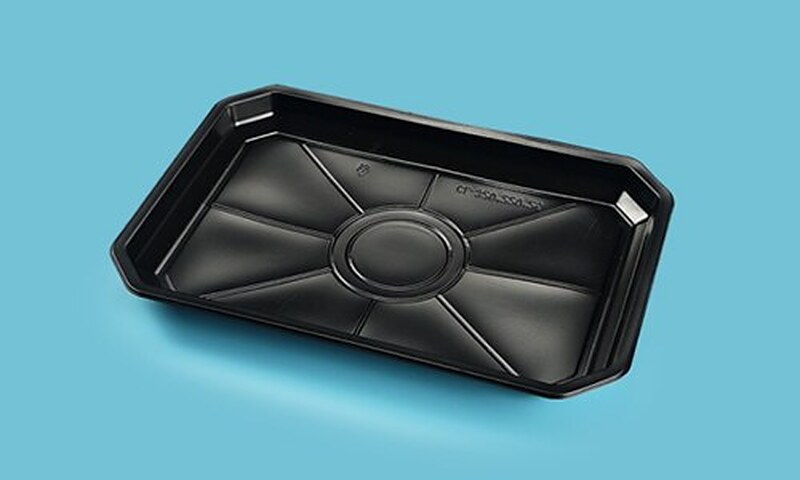
CPET is PET that has been crystallised so it keeps its shape at oven temperature. It is the material of choice for frozen ready meals that are sold to be heated either in a microwave or a conventional oven, and it is stable from deep freeze to about 220°C. It is more expensive and more opaque than PP, and it is usually black or dark so the tray reads as an oven product. Our CPET vs PP frozen tray guide and frozen food tray buying guide cover sizes and lidding in detail.
Where Packs Actually Fail
- Fatty, sugary or saucy food. Oil and sugar can exceed 100°C in a microwave, so a pack rated “microwave safe” for water-based food may still warp. Test with the real recipe.
- Lids and films. A tray might be rated while the lidding film shrinks or seals shut and bursts. Specify vented film or tell the consumer to pierce or peel back a corner.
- Shared multi-material packs. A PP tray with a PET lid, paper sleeve and printed label has the rating of its weakest component.
- Thermal shock. Taking a glass-hard frozen tray straight to a hot oven can crack thin walls. Many manufacturers state a thaw or pre-heat step.
- Arcing. Metal foil trays and decorative metallic inks can cause arcing in microwaves unless the structure is designed for it.
How to Test Before You Order
- Fill with the real food at the real fill weight and seal as in production.
- Freeze to your real storage temperature for at least 24 hours if the product is frozen.
- Heat using the label instructions at two power levels, and again at 1.5 times the label time to find the margin of safety.
- Check warpage, seal integrity, odour, surface melting and any liquid leakage. Handle with care: the food will be hot.
- Record the results and keep them with the specification.
Labelling and Claims
Use clear consumer instructions (“Pierce film, microwave on high for 3 minutes, stand 1 minute”) and the correct symbols for each market. Do not claim “oven safe” unless the whole assembled pack, including lid and label, has been tested at that temperature. For migration and compliance basis, see the FDA and EU guides; migration testing should be run at conditions that reflect your highest intended use temperature.
Quick Selection Guide
- Cold deli and salad only: PET.
- Microwave reheating, chilled or frozen: microwave-grade PP.
- Frozen ready meals heated in either microwave or oven: CPET.
- Short microwave reheating with an eco story: bagasse or rated paper.
Tell us the food, heating method and storage condition and we will propose the tray and lid combination. Contact us for samples and test reports.
Buyer FAQ
Is PP really microwave safe?
Can I put a PP container in the oven?
Why does CPET cost more than PP?
Is PET microwave safe?
How do I prove a tray is microwave safe?
Questions about this guide?
Tell us your product, quantity and target market — our engineers will help you apply it to your project.
Related Guides
CPET vs PP for Frozen & Ready Meal Trays
How to choose between CPET and PP for frozen and ready-to-eat meal trays: oven safety, freezer performance, sealing…
Read guide →
PET vs PP vs rPET vs CPET: How to Choose Food Packaging Plastics
A practical buyer's comparison of PET, rPET, PP and CPET for food packaging: clarity, temperature, sealing, recycling and…
Read guide →Frozen Food Tray Buying Guide: PP vs CPET, Sizes & MOQ
How to choose PP or CPET frozen food trays for dumplings, ready meals and steam buns — sizes, sealing compatibility, MOQ and…
Read guide →Ice Cream and Frozen Dessert Packaging: Cups, Tubs, Lids and…
How to choose ice cream and frozen dessert packaging: PP tubs, paper cups, PET domes, lids, freezer-brittleness, condensation,…
Read guide →