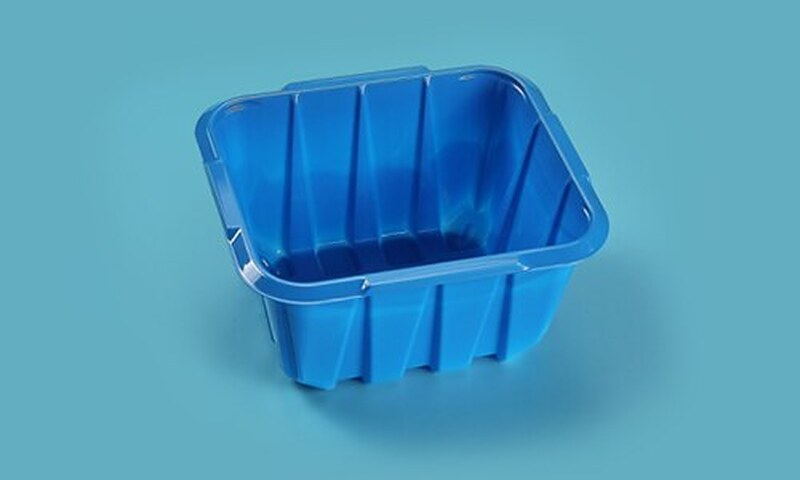
Frozen and ready-to-eat meal programs put a tray through the widest temperature swing of any food-packaging format: a deep freeze, then straight into a conventional oven or microwave, sometimes within the same minute a customer gets home. Choosing the wrong material shows up as warped trays, split seals or a tray that melts at the edges — all after the product has already shipped. This guide compares CPET and PP, the two materials that cover the overwhelming majority of frozen and ready-meal trays.
The Core Difference: Crystallized vs Standard
CPET (crystallized polyethylene terephthalate) is PET that has been heat-treated during forming so its molecular structure locks into a more ordered, heat-stable state. That crystallization is what lets it go from a freezer directly into a 400–450°F conventional or convection oven without warping or releasing anything into the food. Standard PP (polypropylene) doesn't crystallize the same way, but it tolerates freezer-to-microwave cycling well and costs less — it just isn't rated for a conventional or convection oven.
The one-line version buyers should remember: CPET is for anything that might see a conventional oven; PP is for anything that will only ever see a freezer, refrigerator or microwave. Choosing based on your customer's actual reheat instructions — not just habit or what a competitor uses — is the single biggest factor in this decision.
Oven and Microwave Safety
| Material | Conventional/convection oven | Microwave | Typical safe range |
|---|---|---|---|
| CPET | Yes, typically rated to ~400–450°F | Yes | -40°F freezer to ~450°F oven |
| PP | No — will deform or melt | Yes | -4°F freezer to ~250°F |
If your packaging or on-pack instructions say "conventional oven," the tray must be CPET — this isn't a marginal call, since PP will visibly warp and can fail well below typical oven temperatures. If instructions are microwave-only, PP is usually the more economical, equally safe choice, and many ready-meal and meal-kit programs are microwave-only by design specifically to allow the lower-cost PP tray.
Freezer Performance and Shatter Resistance
Both materials handle standard freezer temperatures well, but they behave differently under mechanical stress while frozen. CPET can become more brittle at very low temperatures and is more prone to cracking if a case is dropped or a tray is flexed while frozen solid; PP retains more flexibility in the cold, which is part of why it's the default for trays that go through rough distribution handling as well as freezer storage. If your supply chain includes long-haul frozen trucking with multiple handling points, ask your supplier about the specific gauge and rib design used to reinforce the tray corners, since wall thickness affects shatter resistance more than the base resin choice alone.
Sealing Film and Lidding Compatibility
Both CPET and PP trays are commonly sealed with a peelable or heat-sealed film lid on an automated tray sealer, but the film itself needs to match the base resin and the reheat method. A film rated only for microwave use on a CPET tray intended for conventional-oven reheat creates a mismatch that can fail in the oven even though the tray itself is rated for it — the seal, not the tray, becomes the weak point. Always specify tray, lid film and reheat method together as one system when requesting samples, rather than qualifying the tray alone.
Compartment Layouts for Ready Meals
Ready-meal trays are usually divided into 1–4 compartments to keep sauces separate from starches and vegetables, which also helps even heating since thinner sauce compartments heat faster than a dense protein compartment. Compartment depth needs to be deep enough to prevent sauce migration between cavities during transport and reheat, but not so deep that the center of a thick portion doesn't heat through evenly in a microwave. If you're moving an existing recipe onto a new tray, request a reheat test with your actual filled product rather than approving the empty tray alone.
Cost and Lead Time Considerations
CPET generally costs more per tray than PP at the same gauge, both because of the resin's higher raw material cost and because the crystallization step adds processing time during forming. For programs where only some SKUs need conventional-oven capability, it's common to run CPET for the oven-safe line and PP for the microwave-only line rather than defaulting the whole catalog to the more expensive material. Stocked standard sizes in both materials are typically available from a single carton for trial; custom cavity layouts require new tooling.
Quality Checks Worth Doing on Receipt
- No visible warping or bowing in trays after they've sat at freezer temperature for at least a few hours.
- Seal integrity holds through a full simulated reheat cycle for the tray's intended method (oven or microwave).
- Compartment walls show no cracking after a drop test at frozen temperature.
- Color and opacity are consistent between cartons from the same production run.
- For CPET specifically: confirm the actual rated oven temperature with the supplier rather than assuming a generic "oven-safe" claim covers your specific reheat instructions.
MOQ & Lead Time
Stocked CPET and PP trays in standard sizes can typically ship from a single carton for a trial run. Custom compartment layouts or footprints generally require new tooling, with MOQs commonly starting around 30,000–100,000 pieces depending on cavity complexity, and lead times of roughly 15–30 days after sample approval, plus ocean transit.
Compliance
Both CPET and PP used in food-contact applications need to meet FDA 21 CFR requirements for the resin, and migration data for EU-bound goods. Because these trays typically go through a reheat step, it's also worth confirming the resin's rated temperature range matches your actual labeled reheat instructions — a mismatch here is a product-safety issue, not just a packaging preference. See our FDA food-contact compliance guide for the full documentation checklist to request from any factory.
Buyer FAQ
Can a CPET tray go straight from the freezer into a conventional oven?
Will a PP tray melt in the oven?
Is CPET always the safer default choice?
Can the same tray design be made in both CPET and PP?
How many compartments should a ready-meal tray have?
Does the sealing film need to match the tray material?
Not sure which material fits your reheat instructions?
Send your product's labeled reheat method and current tray dimensions — our team will confirm whether CPET or PP fits and quote the closest stock match within one business day.
Related Guides
PET vs PP vs rPET vs CPET
The full four-way material comparison across every category.
Read the guide →
FDA Compliance Guide
The document checklist to request for any food-contact packaging.
Read the guide →