PFAS (per- and polyfluoroalkyl substances) have moved from a niche chemistry topic to a front-line compliance issue for anyone importing food packaging. They were widely used to make paper and moulded-fibre packs resist grease and water, and a growing number of jurisdictions now restrict or ban them in food-contact packaging. If you sell paper bowls, burger wraps, bagasse plates or microwave popcorn bags, you need a clear PFAS position before your next order.
This article is general information, not legal advice. Rules change quickly and vary by country, state and product, so confirm the current requirements for your market before you rely on them.
What PFAS Are and Why They Were Used
PFAS are a large family of fluorinated chemicals with very strong carbon–fluorine bonds, which makes them extremely resistant to heat, water and oil. They are also extremely persistent in the environment, which is why they are nicknamed “forever chemicals”. In food packaging they were added as a surface treatment or in the pulp to give fibre-based items grease resistance without a plastic film. They were most often found in:
- Fast-food wraps and paper bags
- Moulded-fibre bowls, clamshells and plates (including some bagasse products)
- Microwave popcorn bags and baking papers
- Pet-food and confectionery packaging
Plastic trays and PE-lined board do not need PFAS for grease resistance, but additives, inks and processing aids can still be a source, so PFAS-free must be verified, not assumed.
The Regulatory Picture
| Region | Status (summary) | What it means for you |
|---|---|---|
| United States, state level | A growing number of states have enacted laws that prohibit intentionally added PFAS in food packaging. Definitions, thresholds and effective dates differ by state | Check each state where you will sell; a pack that is acceptable in one state can be non-compliant in another |
| United States, federal | FDA has worked with industry to phase out certain PFAS grease-proofing agents from food-contact use | Supplier declarations should cover current FDA status, not just old letters of no objection |
| European Union | The Packaging and Packaging Waste Regulation (PPWR) sets limits on PFAS in food-contact packaging and applies in stages from August 2026 | Plan for compliance documentation and testing for the EU market |
| Other markets | Several countries are adopting or considering restrictions | Ask your importer or customs broker for the current local rule |
Because details change, treat this table as a map of where to look. Our FDA guide and EU guide explain the underlying food-contact frameworks.
Which Packaging Is Lower Risk
- PET, PP and CPET plastic trays and cups: no PFAS needed for performance. Still request a declaration. See PET vs PP vs rPET.
- PE-coated or PLA-coated paper: barrier comes from the film, not fluorochemicals. See the kraft paper coatings guide.
- Moulded fibre and bagasse: higher risk historically, because grease and water resistance can be added with PFAS. Ask specifically for a PFAS-free declaration and test report. The bagasse guide covers the product category.
How PFAS Are Tested
There is no single “PFAS test”, because the family has thousands of members. Labs use complementary methods:
- Total fluorine screening (for example combustion ion chromatography): a fast screen for any organic fluorine. A low total fluorine result is a strong sign of PFAS-free.
- Targeted analysis (for example LC-MS/MS): measures specific named PFAS at very low levels.
- Extractable or total oxidisable precursor methods: sometimes used to capture compounds that convert to known PFAS.
Ask the lab which method and limit of quantification apply, and make sure the report names the exact product, lot and sample. A third-party report from an accredited lab such as SGS is far stronger than a self-declaration. Reports should be tied to the finished pack, not the raw pulp.
A Supplier Checklist
- Written PFAS-free declaration for each SKU, naming the product and manufacturing site.
- Third-party test report with method and detection limit, recent enough to represent current production.
- Bill-of-materials review: pulp additives, coatings, inks, adhesives and release agents.
- Change-control commitment: supplier must notify you before changing any chemical input.
- Traceability from lot number back to test sample.
- Annual or per-order re-testing for higher-risk fibre products.
Our factory operates under ISO 9001:2015 and BRCGS Packaging, which gives a documented change-control and traceability framework, and we can arrange SGS third-party testing on the finished product for you.
Handling Existing Stock and Claims
- Do not claim “PFAS-free” or “no forever chemicals” without a report covering that exact product.
- If you already hold inventory, test a sample from each lot and quarantine anything uncertain before shipping to restricted states or the EU.
- Keep records: PFAS declarations, reports and purchase specifications for the period required in each market.
Practical Next Steps
- List every fibre-based or coated paper item you sell and where it is sold.
- Collect declarations and reports from every supplier.
- Prioritise testing on moulded fibre and grease-resistant paper.
- Write the PFAS requirement into your purchase specification.
If you need PFAS-free paper, fibre or plastic packaging with supporting test documents, contact us with the products and destination markets.
Buyer FAQ
What does PFAS-free food packaging mean?
Do plastic food trays contain PFAS?
Is bagasse packaging PFAS-free?
How do I prove packaging is PFAS-free?
Do these rules apply in my market?
Questions about this guide?
Tell us your product, quantity and target market — our engineers will help you apply it to your project.
Related Guides
EU Food-Contact Packaging Compliance Guide: EU 10/2011 & REACH
What EU importers should request from a plastic packaging factory: EU 10/2011 Declaration of Compliance, REACH, migration…
Read guide →FDA Food-Contact Compliance for Imported Plastic Packaging: A…
What US importers and retailers should request from a plastic food-packaging factory: FDA 21 CFR declarations, migration…
Read guide →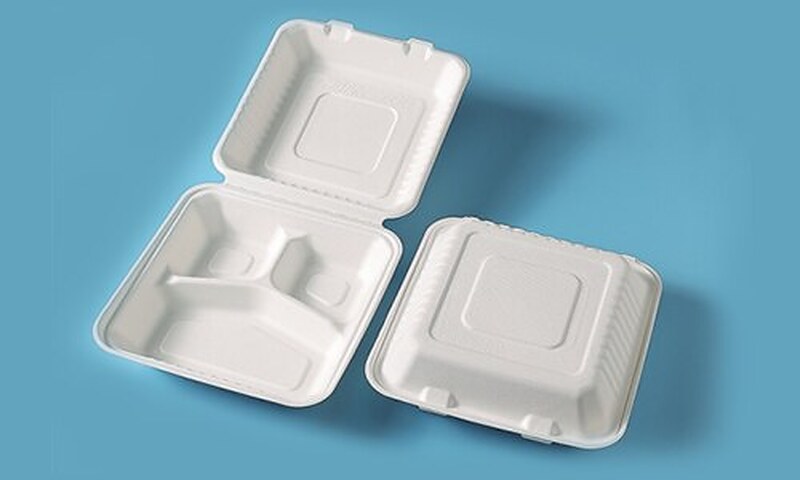
Compostable & Bagasse Food Packaging Guide
What "compostable" actually means, how bagasse compares to PLA and kraft paper, and the labeling claims to get right before…
Read guide →
Kraft Paper Food Packaging: PE vs PLA vs Water-Based Coatings…
How to choose coated kraft paper for food boxes, bowls and cups: PE, PLA and water-based barrier coatings compared on grease,…
Read guide →