Branding a stock tray, cup or box changes it from a commodity item into something a customer associates with your business — but the four common ways to do it differ enormously in cost, MOQ, lead time and what kind of design they can actually reproduce. This guide walks through direct printing, labels, sleeves and in-mold labeling so you can pick the right one for your volume and design.
Printing Methods Compared
| Method | Design complexity it handles | Relative cost | Typical MOQ impact |
|---|---|---|---|
| Direct offset/flexo print | 1–2 color logos and simple graphics | Low per-unit cost, no separate material | Moderate — usually the lowest MOQ increase over an unprinted stock item |
| Printed label | Full color, photographic imagery | Added material and application cost | Lower tooling barrier since it's applied after forming, but a per-unit label cost |
| Shrink sleeve | Full-wrap, 360° full color design | Highest per-unit material cost of the label-based options | Similar tooling barrier to labels; adds an extra shrink-tunnel step |
| In-mold labeling (IML) | Full color, fused into the container wall during molding | Higher upfront cost due to mold modification | Highest — requires mold-specific tooling for IML compatibility |
Direct Offset/Flexo Printing
Direct printing applies ink straight onto the formed cup, tray or lid surface, usually in one or two spot colors. It's the most economical way to put a logo and a brand color on a stock item, and because it doesn't require a separate label material or mold change, it typically carries the smallest MOQ increase over an unprinted order. The trade-off is design complexity: fine gradients, photographic images and large solid-color fields are harder to reproduce cleanly with direct print than with a label.
Printed Labels & Shrink Sleeves
A printed label (applied to a flat or curved surface after the container is formed) or a shrink sleeve (a full-wrap film that shrinks tightly around the container) both allow full-color, photographic-quality designs that direct printing can't match. Labels suit a defined print area like a cup wall or box lid; sleeves suit a full 360° wrap design, such as a cup that needs branding visible from any angle. Both add a per-unit material cost and an extra application step on the production line, which matters if your supplier's line isn't already set up for it — confirm this before committing to a design that assumes sleeve or label application.
In-Mold Labeling (IML)
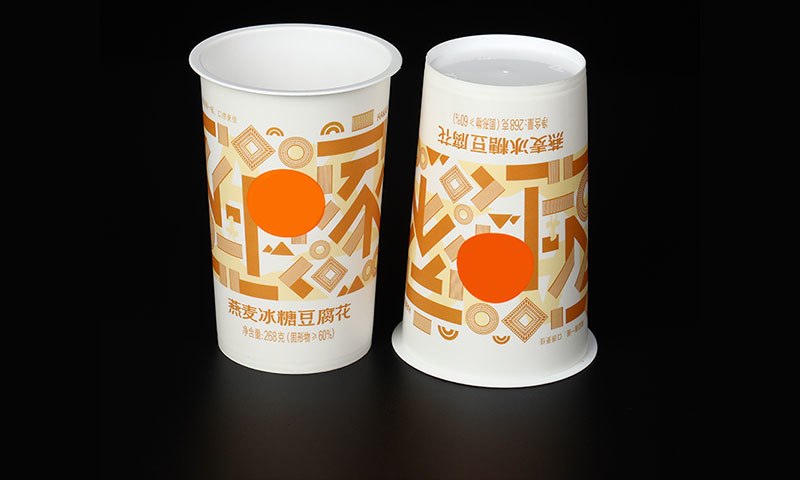
IML fuses a pre-printed label into the container wall during the molding process itself, rather than applying it afterward. The result is a label that's part of the container's structure rather than sitting on its surface, which gives a premium finish and better durability against scuffing than a surface-applied label. The trade-off is tooling: IML requires mold modifications specific to accepting the label, so it's generally the highest upfront investment of the four methods and best suited to programs with sustained, high-volume demand for one design rather than frequent design changes.
Pantone Color Matching
Brand color consistency across packaging runs depends on specifying an exact Pantone reference rather than a general color description like "dark green." Send your Pantone number (or a physical color swatch if you don't have one) at the quoting stage, and ask for a physical draw-down or printed proof against that reference before mass production — a color that looks correct on a screen doesn't always reproduce identically once printed on the actual substrate, since ink behaves differently on a plastic surface than it does on paper or a monitor.
Proofing & Approval Process
Before a full production run, request a physical printed proof (not just a digital mockup) on the actual container material, and sign off on it explicitly rather than assuming a digital approval covers the printed result. This is especially important for label and sleeve programs, where color can shift slightly once applied to a curved or textured surface versus how it looked as a flat proof. Keep a signed or dated reference of the approved proof on file — it's the standard your supplier should be held to on the full production run.
MOQ by Method
As a rough guide: direct printing on an existing stock shape often has the smallest MOQ increase, sometimes achievable at the same threshold as an unprinted trial order for simple one-color work. Labels and sleeves generally require a moderate minimum tied to the label supplier's own minimum run, separate from the container's own MOQ. IML requires the highest commitment since it involves mold-specific tooling, and is rarely cost-effective below a sustained high-volume program. Confirm the specific MOQ for your exact design and container combination rather than assuming a number from another program.
Choosing the Right Method for Your Volume
- Testing a new market or a limited-run promotion: direct one-color printing on a stock shape, to keep both cost and commitment low.
- An established program with a set logo and 1–2 brand colors: direct printing remains cost-effective at higher volumes too, if the design doesn't need photographic detail.
- A premium retail-facing product needing full-color or photographic design: a printed label or shrink sleeve, depending on whether the design is flat-panel or full-wrap.
- A high-volume, long-running SKU where finish quality matters: IML, once volume justifies the tooling investment.
Quality Checks Worth Doing on Receipt
- Printed color matches the approved physical proof, not just the digital file, under normal lighting.
- Print or label registration is consistent across a full case, not just a sample piece.
- Labels and sleeves are fully adhered with no lifting edges or bubbling.
- IML labels show no visible edge lines or bubbling at the container's mold-flow lines.
- Print or label placement is consistent between cartons from different production runs.
Compliance
Printed inks and label adhesives used on food-contact packaging need their own food-contact compliance documentation, separate from the base resin's own FDA/EU compliance. Ask your supplier specifically whether the ink or adhesive system used has food-contact clearance, especially for any print or label area that could come into direct contact with food. See our FDA food-contact compliance guide for the full document checklist, and our custom packaging page for our specific print and tooling capabilities.
Buyer FAQ
Which branding method has the lowest MOQ?
Can we get an exact Pantone match on plastic packaging?
What's the difference between a printed label and a shrink sleeve?
Is IML worth it for a smaller program?
Do we need to test the ink or adhesive for food-contact safety separately?
How do we make sure the color we see on screen matches what's printed?
Planning a branded packaging program?
Send your logo, Pantone reference, target container and expected volume — our team will recommend the right printing method and confirm MOQ and lead time within one business day.
Related Guides
How to Source Food Packaging from China
The MOQ, tooling and shipping basics behind any custom program.
Read the guide →
Custom Packaging
Our print methods, Pantone matching and tooling capabilities.
View custom packaging →